Reviews

The You I’ve Never Known by Ellen Hopkins

the you ive never known

# of Pages: 592

Time it took me to read: 3 days

# of pages a day to finish in a week: 85

Rating: 5 out of 5

Ariel just wants to put down roots. She is a high school senior, and her and her father have never settled anywhere longer than they have here, in Sonora, California. It’s always been just the two of them, Ariel and her dad, living their nomadic lifestyle all over the country. All Ariel has ever known is that the only person she can count on is her father, ever since her mother left them for her lesbian lover.  

Maya’s mother is abusive. All she knows is that she’ll do anything to escape her, even get pregnant and marry an older man, though she’s only 16. When Ariel’s story collides with Maya’s, Ariel begins to understand that everything may not always be as it seems. Ariel’s father has kept secrets, and now that she has found a community in Sonora, Ariel may finally be able to find the strength to discover who she really is.


I have to start out by saying, June has been kind of a dud for me, book-wise. I had this big stack of books that had been sitting on my shelf since I bought them around Christmas, just waiting to get cracked open. But as I’m sure you could tell by my reviews, none of them quite lived up to my expectations of them.

But I knew Ellen Hopkins would never let me down. I have been a fan of hers since high school, and never once has a book of hers disappointed me. I’m sure some of you looked at the page count and are wondering how on earth I read nearly a  six-hundred-page book in three days. Well, it’s really very possible for just about anyone when the pages look like this:
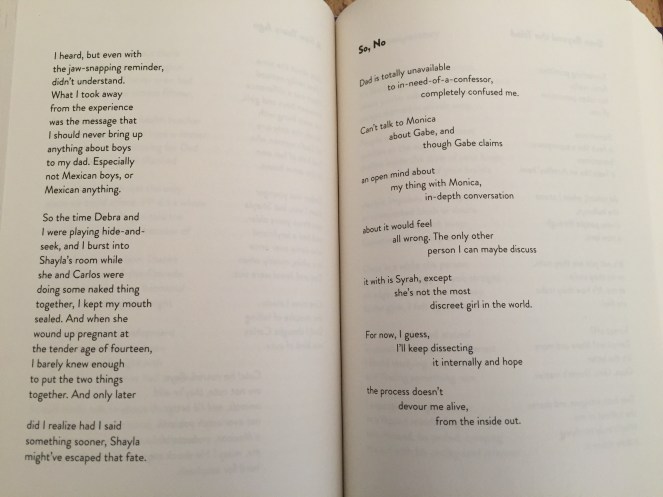
The You I've Never Known interior

Yup. That’s poetry. Ellen Hopkins writes her novels in poetry. An absolutely unique form of storytelling, to my knowledge. The only thing that I’ve ever read that I could compare it to, stylistically, are the epic poems of Homer and Virgil. And, honestly, I think Ellen Hopkins’ books are just as important.

I’m about to go on quite the rant here, because ever since I read my first Ellen Hopkins book when I was about 16, these books have changed me. My first book was Impulse, a story of three teens who tried to commit suicide and were placed in an institution after their attempts failed. I read very nearly that entire book on a two-hour plane ride, and ever since that moment I have been convinced that Ellen Hopkins’ books should be on required reading lists in high schools everywhere.

Why? Because she writes about things that are important. Relevant. She writes about suicide, domestic abuse, drug abuse, rape, sex trafficking, prostitution, teen pregnancy, dealing with death, forgiveness, mental illness…the list could go on. Her books are important. And they are accessible. You don’t have to be a reader like me to enjoy books like this. I even remember two girls in my class in the 8th grade reading Crank, and I always thought if either one of those girls ever touched a book they’d burst into flames.

Not every high schooler goes through the issues that Ellen Hopkins writes about in her books. I certainly didn’t. But there is an unfathomable amount of teenagers, children, who go through these things, and don’t see a lot of representation in media, much less and accurate representation.

And that’s the important part, at least to me. Ellen Hopkins isn’t just sitting up there on her high horse, preaching to teenagers about things that she doesn’t know anything about. Crank, arguably the book that made her famous, is about a young girl, straight A’s, college bound. Then one summer she goes a little wild and ends up getting addicted to crack. And this book? Based upon the struggles of Ellen Hopkins’ own daughter. Hopkins understands the struggles that these youth go through, both through experience and extensive research, but she never, ever talks down to those experiences. These books never feel preachy. They don’t always have happy endings, but they have realistic endings, and their purpose is always a show of support to those out there that are affected by these problems every day.


Okay, whew, end rant. I realize that basically none of the above has to do with the actual, singular book that I read this week, but I’ll get to that now.

I try very hard to be at least a little critical of every book that I read, but with this one I had a really hard time finding faults. The book was paced flawlessly, I was absolutely hooked from the first page, and truly couldn’t put it down for three days. My coworkers even laughed at me when I took it into the bathroom at work.

One of my favorite things about Ellen Hopkins’ characters is that they are always noticeably flawed. Ariel, though truly a good person at heart, is painfully naïve in places, and she can be angry and judgmental sometimes, but can’t we all? Maya is brave and strong-willed, but also very rash with her own dose of naiveté. But the most important part about both of these characters is that they feel absolutely real, in a way that I’ve never really found in books by any other author. Hopkins’ characters feel like people you could meet on the street, and that is a true mark of a great storyteller.

Honestly, if I had to pick one problem, I’d say there was a touch more predictability in this story than in any of her other ones. However, I actually think that is more a problem of the blurb than of the story itself. The blurb on the hardcover of this book is really long, and actually reveals nuggets from the story that you don’t actually learn until more than ¾ of the way through it. But since I, of course, read the blurb, I predicted with nearly perfect accuracy the end of this book. Not to say that I didn’t thoroughly enjoy the ride, but it’s always more fun for me if I don’t know what’s coming, which Hopkins is really good at, I can usually never guess the ending of her books. So, if you decide to read The You I’ve Never Known, don’t read the blurb. Just trust me that it’s worth your time, and read my little description at the top of this review. It’s shorter and more discreet, if I do say so myself.

So hooray, I finally read a five star book this month. I absolutely insist that you check out The You I’ve Never Known, or any other of Ellen Hopkins’ YA masterpieces this summer. You won’t regret it, I promise.


If you liked The You I’ve Never Known, try: Impulse by Ellen Hopkins

Aristotle and Dante Discover the Secrets of the Universe by Benjamin Alire Saenz

I’ll Give You the Sun by Jandy Nelson

Counting by 7s by Holly Goldberg Sloan
Reviews

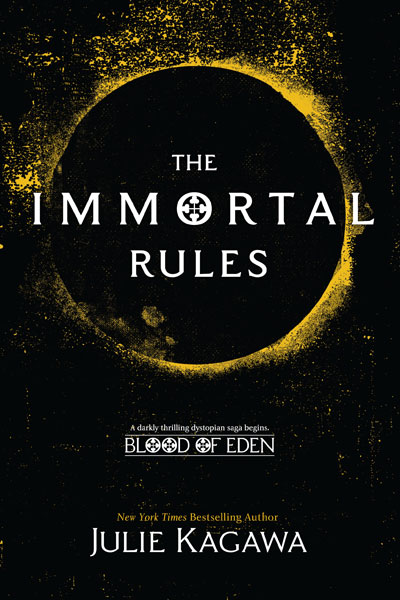
The Immortal Rules by Julie Kagawa

the immortal rules

# of Pages: 485

Time it took me to read: 5 days

# of pages a day to finish in a week: 69

Rating: 3.5 out of 5

Allison has always hated the vampires. They rule ruthlessly over every city, forcing humans to pay a blood tax in exchange for food and protection. And, as most humans who live on the outskirts of the city know, there usually isn’t enough of either one to go around. But the vampires aren’t the worst monsters out there. The city walls keep the people of New Covington safe from the rabids, horrible creatures mutated from those who were once sick from the plague that took out most of humanity. When a journey outside the wall goes wrong, Allison is forced to make a choice: die a painful death, or become one of the creatures that she so despises.  

Zeke and his makeshift family have been searching for Eden, a city free of vampire influence, for many years. When Allison stumbles upon Zeke and his group, her decisions will determine who she will become. Will she cling to her own humanity, or embrace the inner demon raging inside?

I feel as if I have to start out by saying that I am a huge, long-time fan of Julie Kagawa. Her Iron Fey series was one of the first to get me into reading books about the fairy folk. So this series, The Blood of Eden, is quite the split from what I know of her.

This story, like basically every book I’ve read this whole month, took me quite some time to get into. I feel like this book spent a lot of time on backstory, which, if it were me, I would have put in flashbacks throughout. The whole first half of this book is leading up to the catalyst of the entire series, which is Allison joining a group of humans to find the one city on the continent free from vampires and rabids. This doesn’t happen until about page 200, which seems excessive to me.

Sorry, I’ll end my rant there. In the end, this book won me over. I really enjoyed Zeke as a character, and honestly I think that his effect on Allison really warmed her to me. Allison seems to flip flop for a lot of the beginning of the book. Sometimes she’s aloof, sometimes she is serious and pensive, and then sometimes she is this total smart mouth. It seemed fairly inconsistent to me, but she evens out when she joins Zeke and his group of Eden seekers.

I’m totally on the hook for the series, though, because I think that this whole post-apocalyptic vampire story is a pretty neat twist. I’ve read lots of dystopia, and usually if they pick a monster, they pick machines or zombies. I’ve never read one that picked vampires, before, and it’s certainly an interesting twist because, typically, zombies aren’t that interesting to read about as characters because they basically only have one primal motive. Vampires are much more human, and I think that Kagawa weaves them into her post-apocalyptic tapestry brilliantly.

I have to say, it’s kind of fun going back into the world of vampire books. I used to read a lot of vampire books in my high school days, but it has been quite a while now, and I’ve noticed the trend is dying down rapidly in YA.

The kind of sad thing is, that this was probably my favorite book that I’ve read so far this month, and it only has a 3.5 rating. I’ve been hitting a couple of duds in a row on my stack, but I’m going on a Barnes and Noble run soon, so hopefully the last week of the month will yield something more promising. But if you’re a fan of dystopia and vampire books, I certainly recommend The Immortal Rules, as it is a fascinating blend of genres that you can really sink your teeth into (I’m not sorry for the pun).

If you liked The Immortal Rules, try: The Iron King by Julie Kagawa

Dearly, Departed by Lia Habel

The Coldest Girl in Coldtown by Holly Black

Peeps by Scott Westerfield

Reviews

The Scorpion Rules by Erin Bow

the scorpion rules

# of Pages: 374

Time it took me to read: 5 days

# of pages a day to finish in a week: 54

Rating: 3 out of 5

Greta has lived her whole life knowing that she will probably die for her country. When the world was torn to pieces by the War Storms, Talis, a form of artificial intelligence that was once a man, stopped humans slaughtering each other by decreeing that the leader of every nation on earth must submit a child to be held hostage. These child hostages would be kept safe on the condition that their parents not set their countries to war. It is not always easy, however, and during her life as a hostage, Greta has seen many children taken away to die for the sins of their parents. She accepts it. Until a new hostage arrives and teaches her that she has a choice. And it is at this time that Greta understands that she has the power to make a change.

This book really stumped me. I honestly feel as if I both do and don’t have a lot to say about it. I spent the first half of the book really thinking I knew what it was going to be about. The blurb and the beginning of the book really painted the story as a political intrigue novel, and Greta is surrounded by a delightfully diverse and enjoyable cast of fellow “Children of Peace” (read: hostages). Greta is a strong-willed, intelligent character, but fairly oblivious to the human condition.

I’ve read quite a wide variety of dystopia in my day, ranging from The Hunger Games to Divergent, all the way to zombie stories. I thoroughly enjoy the genre and think that it’s rising popularity is fascinating when you consider how frightening our world has become in the last fifteen years or so. But that is an entirely different conversation.

What I have always liked about dystopia (which is defined as a post-apocalyptic story that often explores a wide range of subjects such as political systems, disease, technology, etc.) is that despite taking place in a world that is very alien from our own, we are able to relate to the characters through shared humanity. For example, feeling empathy when a character makes a decision in a situation that you feel you would make if in their shoes, or sympathy when a character has something happen to them that you may not be able to directly understand, but that character’s emotions are familiar enough that you feel for them.

Interestingly enough, Greta goes through a similar transformation to Nemesis from last week’s The Diabolic. Greta, however, goes down a path that was, really, impossible to foresee and sort of the polar opposite of Nemesis.

Okay, I really don’t want to give anything away to folks out there who’d like to give this book a shot, so I’ll stray away from spoilers and move toward giving a more abstract review of the book. I really enjoyed the setup of this world, and I felt as though I understood it very well without feeling like Erin Bow had to over-explain it to me. As I said before, my favorite characters were Greta’s fellow hostages, who were all so three dimensional as characters and who had such strong and captivating personalities. The pace of the book was also very nice, and it was not so slow to start as other books I’ve read recently.

However, try as I may, there is no such thing as an unbiased book review. I gave this book 3 out of 5, because though there were aspects of this book I very much enjoyed, and can respect that this book overall was well researched and well written, by the end, I did not like it. I really had to think, and was really frustrated and confused as to why I was feeling the way that I was. And though this may be a disappointing answer, I think it’s purely a matter of taste. I don’t like the direction the author took with this story (and with the first 150 pages or so, there were a lot of directions she could have taken it). I think that she probably took the most interesting turn that she could have, and I’ve looked online and read mountains of praise on it. But I cannot entirely add to that praise.

The most telling thing for me, at least, is that the sequel is available right now…and I don’t think that the ending interested me enough to read it. That, and I think that most of the secondary characters that I loved so much will not be as involved in the sequel. So that’s a real downside for me.

To wrap this thing up: if you like dystopia, there is a very good chance you’ll like this book. It’s well written and intelligent, and the characters are, for the most part, dynamic and interesting. However, my favorite thing about this genre is, like I said, finding the relatable humanity in an alien world, and the protagonist just does not have that relatable quality that I like. So this book gets a 3 out of 5, out of personal respect for the quality of this book, but loses points based on totally personal reasons.

If you liked The Scorpion Rules, try:

The Forest of Hands and Teeth by Carrie Ryan

Divergent by Veronica Roth

Uglies by Scott Westerfield

The Maze Runner by James Dashner

Reviews

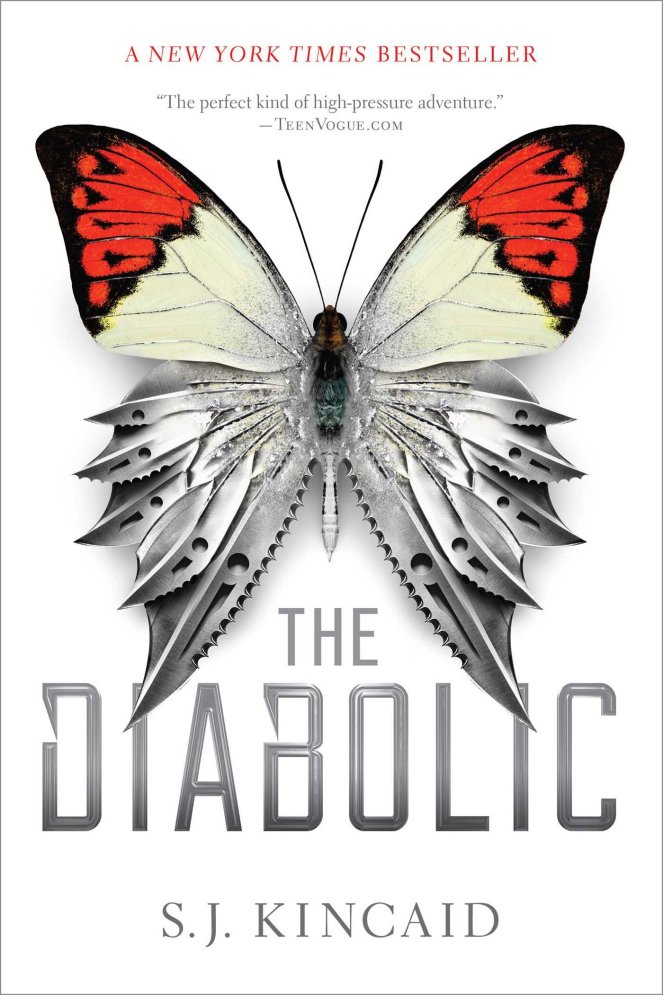
The Diabolic by S.J. Kincaid

The Diabolic

# of Pages: 403

Time it took me to read: 5 days

# of pages a day to finish in a week: 58

Rating: 3.5 out of 5

Nemesis is not human. She is a Diabolic, a humanoid creature bred to be a bodyguard to the sons and daughters of the Grandiloquy, the ruling class of the galactic empire. Nemesis is bonded to Sidonia Impyrean, who is the daughter of the senator that is the greatest threat to the Emperor himself. When Sidonia is called to court as a glorfied hostage, Nemesis knows what she must do to save the girl she is sworn to protect. She must become her. While in disguise, Nemesis must learn what it truly means to be human, and her actions may cause the biggest shift in her empire’s history.


You know, I have to start out by saying that this book was a bit of a branch-out for me. Though I am a life-long lover of Star Wars, I’m not really that into sci-fi. I don’t really have a base knowledge of the structure of sci-fi in the same way that I do for fantasy. And through the beginning of this story, I thought that it might become a problem for me.

This story, like many of the books I’ve been reading lately, was slow to start for me. While the concept of this story is immediately apparent and immediately fascinating, to me it takes a little bit too long for the whole concept to be explained. Basically, the entire first 100 to 150 pages was an explanation of the science, the political system, and the religion of this world. And while it’s all very well thought out and fascinating, it doesn’t leave much room for a lot to happen plot-wise. It also didn’t help me to begin to feel attached to the characters, though Nemesis herself I believe is a very interesting character study.

In my many years reading as many books as I could get my hands on, I came across many main characters that weren’t strictly human. But I would classify all of them as “people”, a broad term that, to me, describes any creature that has feelings and thoughts and makes decisions that we, as the reader, can understand as choices that we might make if we were in that position. But reading this book from the perspective of Nemesis, at least in the first half of the book, is really very intriguing because it is almost like reading from the perspective of a robot.

Nemesis is technically human-like, bred with intense physical strength and supposedly “modified” brain capacity, but she doesn’t think or act like a human would, and she doesn’t see herself as human. I think that, overall, Nemesis as a character is the greatest triumph of this book.

I have to give Kincaid all of the points for character and world building, absolutely brilliant. Her political system is largely based off of the Roman Imperial system, which I love because I am a total classical history nerd. The only reason that I can’t give it a higher rating isn’t really a problem for me, but I suspect would be a problem among the more selective readers out there. And that problem is predictability.

If you read enough books, eventually you start to pick up a pattern. Am I still surprised by books? Absolutely. Do I go looking for the patterns in every book so as to basically “ruin” the story for me? Absolutely not. I take pride in being able to take a book page by page, so that even if I look back on the book after I’ve finished it and decide that I wasn’t really surprised by anything that happened, I can still say that I enjoyed the book overall.

I think the biggest problem that Kincaid has in this story is giving the story away to the reader ahead of the character. She drops all these fairly obvious hints about what is about to happen, and so the reader knows, but it takes Nemesis or Tyrus or whoever pages and pages more to figure it out, even though some things are totally obvious and both of these characters are extremely intelligent. It certainly exasperated me a few times, even though I very much enjoyed the book as a whole.=

Long story short, I would absolutely recommend this book to folks who like young adult, even if you don’t like sci-fi, because after the beginning part it becomes very friendly and easy to follow even for those who aren’t super familiar with the genre. If predictability is a big problem for you, however, I’d maybe pass this one by (though the last 30 pages actually did hold a few surprises for me, so it certainly ended on a positive note).

If you liked The Diabolic, try: Graceling by Kristin Cashore

Cinder by Marissa Meyer

The Golden Compass by Phillip Pullman

Matched by Ally Condie

Reviews

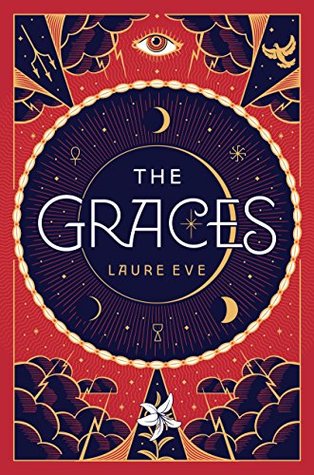
The Graces by Laure Eve

the graces

# of pages: 336

Time it took me to finish: 4 days

# of pages a day to finish in a week: 48

Rating: 2 out of 5


River is a nobody: a blank slate in a new town. But the Graces are the most powerful family around, and anyone who meets them is immediately under their spell. No one else feels their influence as intensely as River, and she knows from the moment that she lays eyes on them that she will do anything to be loved by them, each and every one. Because River has a secret, and she knows if anyone can help her face the darkness of her past, it’s the Graces.


So, first of all, I just finished this book, like not ten minutes ago, and I decided that I needed to write this review right now, because this book fills me with rage.

So the book starts with our protagonist River. She seems to me, immediately, like one of the flattest characters I’ve ever read. Like she’s just this ordinary girl with this “dark past” that she won’t go into, and she is obsessed with this family, the Graces, in her new town. They are beautiful, rich, and powerful in a seemingly unearthly way, and of course she is undyingly in love with the boy one. River, she wants to be one of them. Every second of each interaction with them is her carefully posturing her way in, because the Graces didn’t have best friends, didn’t have confidents. But she would become one.

You know what this sounds like to me? This book, for the first 250 pages of it, reeked of Twilight. The Graces? Basically like the Cullens. But instead of vampires? Everyone in the town thought that they were witches. But to me, River seemed even more pathetic then Bella, predictable and unrelatable. River, like Bella, was irresistibly attracted to the Graces even though they were bad for her. The first huge chunk of this book was a total snooze-fest, one that I was determined to get through, if only so I could give it a scathing review on my blog.

But boy, oh, boy, was I tricked. The last hundred pages of the book went in a direction that I could not have possibly predicted. I won’t spoil it for you, just in case you decide to pick it up, but let me just say that I was insanely surprised at the end. I still don’t like River, never liked River, but I think that I understand now that I’m not supposed to. I still think that River is a character that is not written entirely well, I think that she makes decisions that seem very random and out of character throughout the book, and that her inner monologue is erratic, and not necessarily in the way that the author intended.

I do have to give Laure Eve some credit, though. She certainly did not go with the easy ending. And the twist at the end was a damn good one. Another thing that I have to give Eve some credit for is style: she goes into insane detail with the, well, details. All of her characters’ physical traits, and the settings, are meticulously described, and it’s clear that Eve has a very clear picture in her head of what everything looked like.

I didn’t like this book overall, as is clear by the rating. And I don’t think I can really bring myself to recommend it to anyone, either. But will I be reading the sequel that’s going to drop in January? Yeah, probably. But I won’t be happy about it. I’m still incredibly mad that the last hundred pages hooked me. It feels like cheating, you know? Like I didn’t enjoy most of the book, but the twist and the cliffhanger force me to need to know what happens. But any parts of my little rant sound like they might appeal to you, go ahead and give this book a shot. And if anyone does, please hit me up with what you think about it? I’m dying to hear the opinion of someone else.

Reviews

The Reader by Traci Chee

the reader

# of Pages: 437

Time it took me to read: 1 week

# of pages a day to finish in a week: 63

Rating: 4 out of 5

An ethereal fantasy, The Reader follows young Sefia, who lives her life on the run along with her aunt Nin, the only family she has left. After Nin is captured by their enemies, Sefia must learn to fight and survive on her own, guided only by a mysterious object left to her by her parents. With the help of Archer, a boy who was kidnapped as a child and trained to be lethal, Sefia learns the power of the written word and hunts for those who have taken her aunt and appear to have the answers that she has always been seeking.

Let me start off by saying that this book was not an instant hit for me. I didn’t start out feeling super attached to our young protagonist, Sefia, and the plot didn’t run away and take me with it right off the bat. But I was determined not to give up on this book, because it did have one thing going for it from page one: it was so pretty.

Now, as I am not one of the “prettiest” writers in the world, I instantly have envy for authors who weave their words together like music and make every sentence truly lyrical. If you like writers like that, too, check out Maggie Stiefvater, one of my YA favorites (her Raven Boys is truly to die for). But I have to say that Traci Chee must have a silver tipped pen, because she does not write like this is her YA debut. So she certainly got full points for style, and for that reason, there was no way I wasn’t going to give this book a full chance.

I think it took the introduction of Archer, the voiceless, destructively loyal boy that Sefia picks up during the desperate search for her aunt, to really spark my interest. Chee does an excellent job of describing the way that Archer and Sefia create a language for themselves, one that involves gestures and facial movement. Because that is what this book is about, after all. Language, in all the shapes and forms that it takes.

One of my favorite books growing up was Cornelia Funke’s Inkheart. I think almost everyone who is a vicarious reader cannot help but love Inkheart because it’s one of those meta books, you know? Like it’s about characters who are readers, it’s about telling stories, and bringing words to life in a way that we in the real world can only dream of. Any fans of Inkheart should certainly pick up The Reader, because it has that exact same meta feel to it. In Chee’s world of Kelanna, the written word has immense power, and only a select few are trusted with the secret knowledge of how to read and write.

By the end of this book, I was very disappointed to have to put it down. I fell in love with the unique, vibrant world of Kelanna, and Chee’s wacky cast of characters really grew on me. It took about half way through before the plot started to really move, for me at least, but in the end I think that Chee makes up for it with incredible attention to character growth and world detail. I certainly can’t wait for book two, and in the mean time I hope I can convince you to pick up The Reader, Book One of Sea of Ink and Gold.

If you like The Reader, try: The Raven Boys by Maggie Stiefvater

              Inkheart by Cornelia Funke

Daughter of Smoke and Bone by Laini Taylor

              Shadow and Bone by Leigh Bardugo